
Platform overview
Fontana ships as an integrated stack you can run on major clouds or on-premises: a modern web app, real-time backend, workflow engine, identity plane, secrets store, observability, and connector runtime, each with a clear role in production. The sections below cover platform capabilities, the technology stack in a typical workspace, and how external services are bounded.
Platform capabilities
Section titled “Platform capabilities”Fontana delivers governed capabilities for data, workflows, and AI. Each area below is a first-class part of what you run in production.
- Governed AI - Your approved LLM gateways and models, BYOK key scoping at org, team, or person level, agents and skills, Knowledge Graph retrieval, tools, MCP, and agent interop under one control surface.
- Workflow orchestration - Visual pipelines on the Flow canvas, reactive server-side execution, node families for transforms and connectors, plus built-in validations, conditions, and document parsing.
- Identity and access - Self-hosted Zitadel per workspace with OIDC, corporate SSO, MFA, SCIM provisioning, and application RBAC in Flow for teams and admin surfaces.
- Data - File uploads, PyAirbyte connectors, encrypted Arrow storage, REST triggers, and governed export
- Observability - Platform Grafana for OTLP logs and dashboards, Gatus health history, and workspace observability routing alongside the security audit ledger.
- Deployment - cloud, self-hosted, architecture, hardware requirements, backup and restore, Fontana CLI
- Security - namespace-per-workspace isolation, Vault secrets, encryption, network hardening, supply chain integrity, and SOC 2-aligned control summary
- Compliance evidence - workflow data lineage and immutable security audit trail
Architecture
Section titled “Architecture”Fontana runs on native Kubernetes. Ingress and certificates live in a system namespace, shared services in a platform namespace, and each workspace gets a namespace of its own holding Flow, the backend, the Knowledge Graph, the workflow engine, Vault, identity, and its data.
Topology diagram
Section titled “Topology diagram”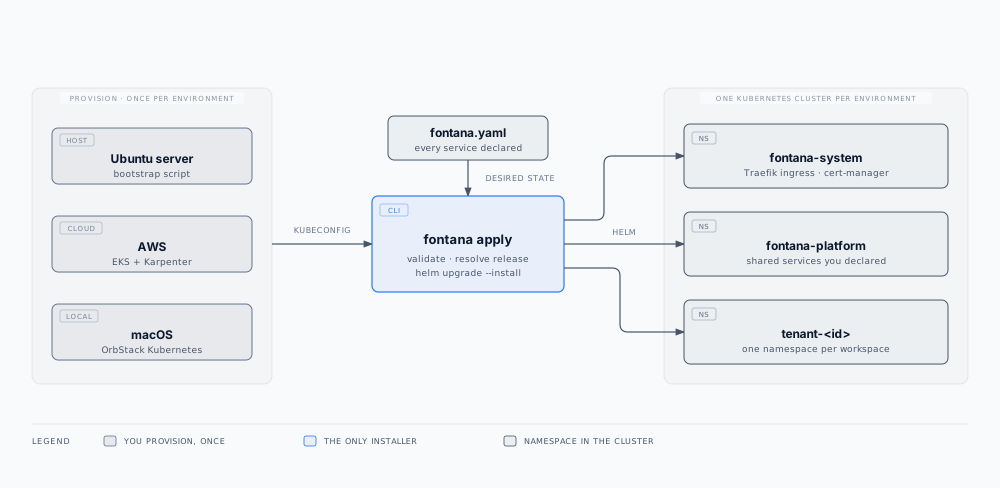
Component breakdown and deployment models: Deployment architecture.
Technology stack
Section titled “Technology stack”The table below summarises the major components in a typical workspace and what each one does.
| Component | Technology | Role |
|---|---|---|
| Infrastructure | AWS / Azure / GCP / on-prem | Deploy anywhere - platform-agnostic infrastructure |
| Container orchestration | Kubernetes (EKS or k3s) | One cluster per environment, with per-workspace namespace segregation |
| Flow App | Modern React PWA | Web UI - canvas, grids, AI chat, admin panels |
| Workflow engine | Node.js, Python | Server-side execution of workflow graphs |
| Real-time backend | Convex | Application backend - config, AI orchestration, persistence |
| Knowledge Graph engine | Graph database | Per-workspace entity/relationship graph and GraphRAG vectors |
| Auth | Zitadel | Self-hosted OIDC identity per workspace - SSO, MFA, SCIM provisioning |
| Secrets storage | HashiCorp Vault | Per-workspace encrypted secret storage (API keys, connector credentials) - SOC 2-aligned controls |
| Observability | Grafana | Platform-cluster OTLP collector and operator dashboards (shared across workspaces) |
| AI code sandbox | OpenSandbox | Isolated code execution for agents via MCP |
| Data replication | Airbyte (PyAirbyte) | Data ingress and egress - catalog connectors in the workflow engine |
External services
Section titled “External services”Fontana is designed for security and contractual control: the platform stack above runs inside your Kubernetes boundary with per-workspace Postgres, Convex, FalkorDB, Vault, and Zitadel. Fontana does not operate a shared LLM pool or route production inference through Fontana-owned model accounts. Your workspace data is not sent to external data processors for platform operation beyond what you configure and approve.
When you use AI, requests leave the workspace only through LLM gateways and providers you choose. You store credentials with Bring Your Own Key (BYOK) in per-workspace Vault and, in Admin, approve which gateways and model IDs are reachable in production. Fontana supports 20 gateways (unified routers such as OpenRouter and LLM API, direct vendor APIs, cloud-hosted foundation models on AWS Bedrock, and Custom & Self-Hosted endpoints) and 300+ models behind one governed routing layer. Spend, retention, training policy, and Zero Data Retention (ZDR) posture follow your provider contracts and gateway settings, not a shared vendor account Fontana operates on your behalf. See Bring Your Own Key (BYOK), Zero Data Retention (ZDR), Governed AI, and Gateways for key scoping, retention posture, and approval workflows.
You may also connect to external systems through connectors, REST and GraphQL triggers, and MCP servers when your workflows require them. Connector and API secrets resolve from Vault at execution time; nothing is embedded in workflow config. Operational telemetry and security audit routing stay within the model described in Observability.